
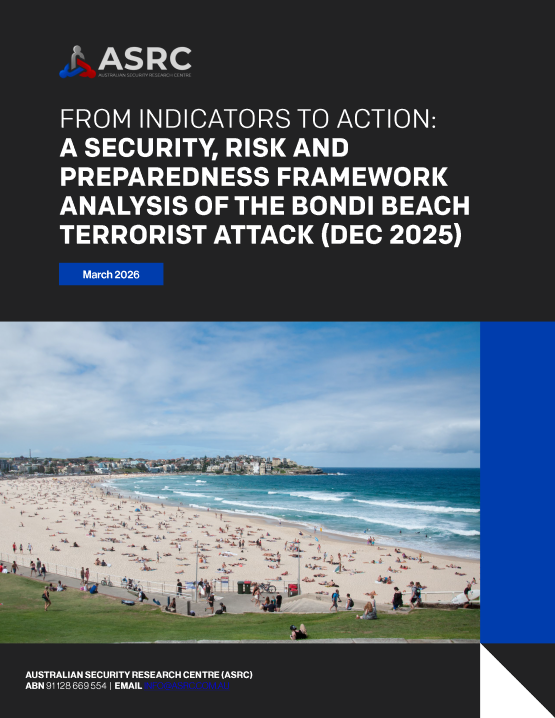

A systems-based examination of the Bondi Beach terrorist attack, identifying the capability gaps, decision points and preparedness lessons relevant to organisations, government and critical infrastructure operators. Published by the Australian Security Research Centre (ASRC).
Research and security insights
Why this report matters
The Bondi Beach terrorist attack was a defining security event that tested preparedness, response coordination and risk governance across multiple sectors.
While the incident occurred in a public setting, the lessons extend well beyond the immediate response. They apply to organisations responsible for:
- public safety
- critical infrastructure
- workforce protection
- duty of care
- risk governance
- emergency preparedness
This report examines the incident not as a single event, but as part of a broader system of risk recognition, escalation and operational decision-making.
It provides a structured framework for understanding how indicators emerge, how decisions are made and how preparedness can be strengthened before, during and after an incident.
PEOPLE • ASSETS • OPERATIONS
Who this report is for
- Government and public sector leaders
- Protective security and risk professionals
- Critical infrastructure operators
- Emergency management and resilience teams
- Corporate risk and governance leaders
- Security and safety managers
- Board members and executive leadership teams
- Policy and regulatory professionals
If your organisation has responsibility for people, assets or operations, this report is relevant.
PROFESSIONAL RELEVANCE
What you will learn
How risk indicators evolve prior to a critical incident

How threat recognition and escalation decisions occur in practice

Where preparedness and coordination gaps commonly emerge

How response capability interacts with governance and policy

What organisations can do to strengthen readiness before an event

How leadership and operational teams can improve decision-making under pressure

About the report
This report presents a structured analysis of the Bondi Beach terrorist attack using a systems-based risk and preparedness framework.
The analysis examines:
Threat context and indicators
Preparedness posture
Operational response
Coordination dynamics
Governance and decision-making
Capability implications
Rather than focusing solely on the event itself, the report identifies the conditions, signals and decisions that shape outcomes during critical incidents.
The findings are intended to support stronger preparedness, clearer escalation pathways and more effective operational coordination across organisations and sectors.
Key themes identified in the analysis
- Preparedness is a system, not a single function
- Risk recognition depends on information flow and escalation
- Response capability is shaped before the incident occurs
- Coordination requires clear authority and decision thresholds
- Governance and operational practice must be aligned
- Leadership decisions influence outcomes under pressure
These themes reflect the report’s central argument that capability outcomes are driven by preparedness conditions established prior to the event.
The findings reinforce that attacks of this nature rarely occur in isolation; they emerge within complex environments of warning signals, policy settings, and operational constraints.
By examining how threat recognition translates into preparedness and how harm is often determined during the execution phase of an attack, the research highlights practical opportunities to strengthen Australia’s crowded-place protection framework without undermining the principles of proportionality, accessibility and civil liberties that underpin it.
I believe that the study contributes to a constructive national conversation about public safety and security, helping governments, security professionals and communities alike refine how we anticipate risk, coordinate response, and reduce the potential for harm in the future.

Tony Pearce MAICD
Crisis and Emergency Management Advisory ServicesRequest a Briefing for Your Organisation or Board
The Australian Security Research Centre provides structured briefings tailored to organisations seeking to understand the operational and governance implications of the Bondi Beach terrorist attack.
Briefings can be delivered to:
Australian Security Research Centre
About ASRC
The Australian Security Research Centre (ASRC) is an independent research and thought leadership organisation dedicated to advancing security, risk and resilience capability across government, industry and the broader community.
Founded to bridge the gap between academic research and real-world security practice, the ASRC translates complex risk and threat environments into practical, actionable insights that support preparedness, decision-making and operational effectiveness.
Our work spans the full spectrum of security and risk, from emerging threats and human factors to national preparedness and organisational capability. Through research, publications, and strategic forums, the ASRC provides evidence-based insights that help organisations strengthen readiness, improve coordination, and respond more effectively to complex incidents.
What We Do
The ASRC delivers applied research and capability development that supports:
Our research is designed not only to inform understanding, but to improve practice.
Why Organisations Trust ASRC
The ASRC combines academic rigour with practitioner insight and operational experience. This unique approach enables us to produce research that is both intellectually robust and immediately usable by decision-makers responsible for safety, security and risk.
As part of the Risk 2 Solution Group, the ASRC benefits from national capability, professional expertise and strong governance frameworks, while maintaining the independence and integrity required for credible research and public value.